

If you want more control over your money without paying for another subscription, a free finance tracker can be the simplest upgrade to your financial life. The key is choosing (and using) a tracker that does three jobs well:
- Track accounts so you always know what you have, what you owe, and what is coming in.
- Track bills so you stop losing money to late fees, missed payments, or surprise renewals.
- Track progress so your day-to-day decisions connect to bigger goals like debt payoff, emergency savings, or net worth growth.
This guide walks through what to track, how to set up your system quickly, and how to review progress in a way you can actually maintain.
What a free finance tracker should help you see (at a glance)
Many people think “budgeting” is the whole game, but budgeting is only one layer. A solid finance tracker ties together four views:
1) Cash flow (month-to-month)
Cash flow answers: Did I bring in more than I spent? It helps you catch lifestyle creep, irregular expenses, and subscription bloat.
2) Account balances (day-to-day)
Balances answer: What do I have available right now, and where is it? This is especially important if you use multiple banks, credit cards, and payment apps.
3) Bills and obligations (week-to-week)
Bills answer: What must be paid, by when, and from which account? This reduces late payments and protects your credit profile.
4) Progress metrics (month-to-month, quarter-to-quarter)
Progress answers: Am I getting closer to my goals? Progress can include debt payoff, emergency fund milestones, investing consistency, and net worth trends.
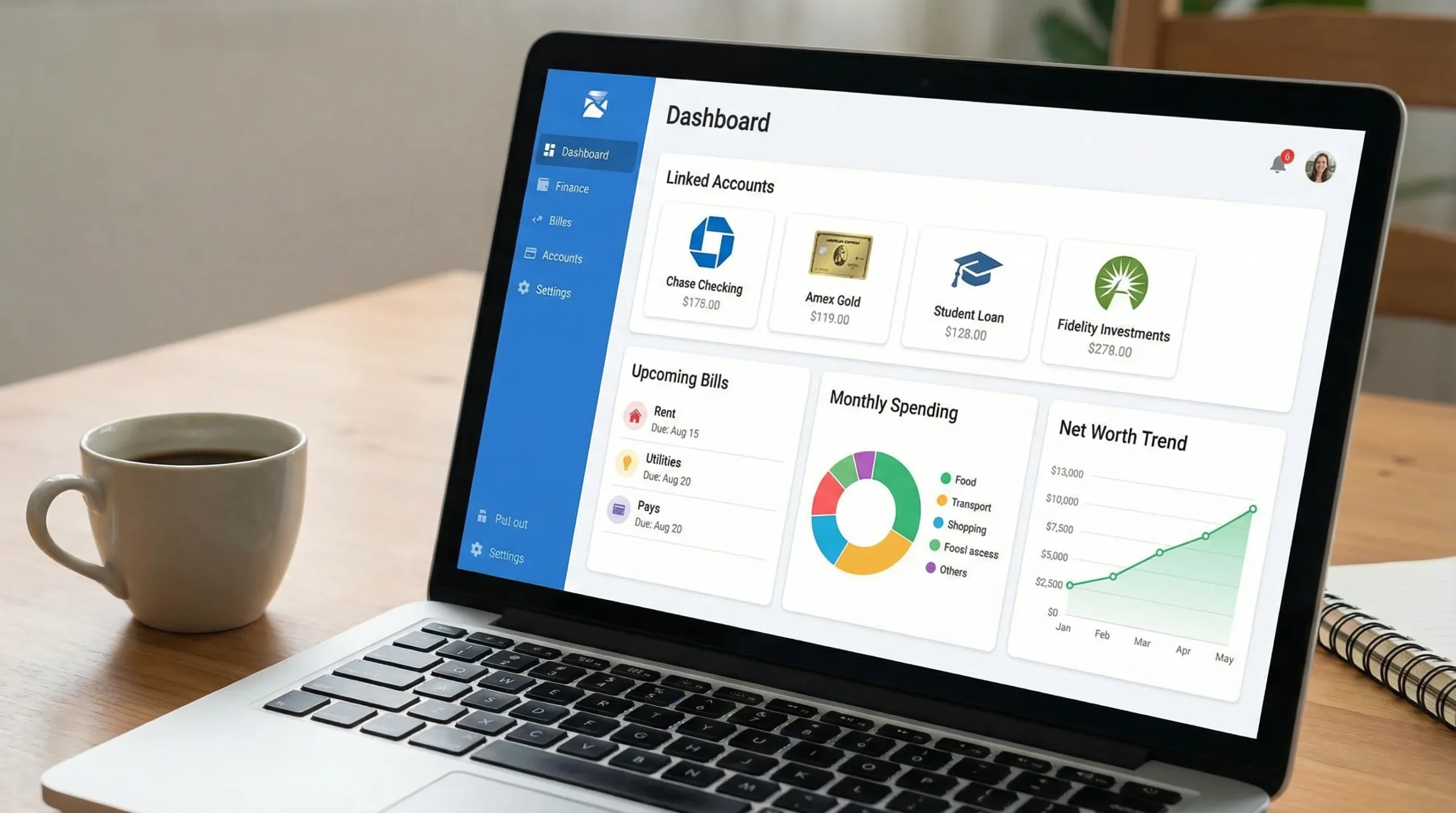
A 30-minute setup that covers accounts, bills, and progress
You do not need a perfect spreadsheet or a complex budgeting philosophy. You need a setup you will keep using.
Link your financial accounts (then confirm starting balances)
Start by connecting the accounts that represent your real financial picture:
- Checking and savings
- Credit cards
- Loans (student loans, auto loans, mortgage)
- Investments (brokerage, retirement accounts)
Once synced, do a quick “sanity check” by comparing a few balances and recent transactions to your bank or card statement. Most tracking problems come from small issues early on (duplicate accounts, old closed cards, incorrect categories) that compound over time.
Add recurring bills and due dates
Bills are where a tracker earns its keep. Create a recurring list that includes:
- Rent or mortgage
- Utilities and phone
- Insurance
- Minimum credit card payments
- Loan payments
- Subscriptions that renew monthly or annually
If you do nothing else, maintaining an accurate bill calendar can prevent expensive mistakes.
Pick one simple way to categorize spending
Categories should help you make decisions, not create busywork. A practical approach is:
- Fixed essentials (housing, insurance, loan payments)
- Variable essentials (groceries, gas, utilities)
- Financial goals (extra debt payments, savings, investing)
- Lifestyle (restaurants, entertainment, shopping)
If your tracker supports rules or recurring categorization, use them. Consistency matters more than precision.
Choose 1 to 3 “progress metrics” to review monthly
Too many metrics leads to avoidance. Pick a small set that matches your current priorities:
- Net worth trend (assets minus liabilities)
- Credit card utilization (how much of your credit limit you are using)
- Emergency fund runway (how many months of essentials you could cover)
- Debt payoff pace (principal decreasing month over month)
The Consumer Financial Protection Bureau (CFPB) also publishes practical guidance for building spending plans and staying on top of bills, which pairs well with app-based tracking if you want a government-backed baseline for money habits: CFPB budgeting resources.
How to track accounts effectively (without obsessing)
Account tracking is not about checking balances every hour. It is about noticing issues early, like fraud, fee creep, rising debt, or an account that is quietly draining.
What to monitor by account type
| Account type | What to track | Why it matters | Review cadence |
|---|---|---|---|
| Checking | Balance buffer, upcoming bills | Prevent overdrafts and payment failures | 1 to 2 times per week |
| Savings | Emergency fund progress, transfers | Keeps goals “real,” not just aspirational | Weekly or monthly |
| Credit cards | Statement balance, due date, utilization | Avoid interest, late fees, and credit score damage | Weekly, plus before due date |
| Loans | Principal trend, interest rate, next payment | Confirms you are actually reducing debt | Monthly |
| Investments | Contributions, allocation drift | Progress comes from consistency, not constant trading | Monthly or quarterly |
Reconcile transactions so reports stay trustworthy
Most people abandon trackers because reports stop matching reality. Reconciliation is the fix.
A sustainable routine is:
- Review recent transactions (especially “uncategorized”)
- Confirm duplicates are not inflating spending
- Split mixed purchases when needed (for example, a warehouse store run that includes groceries and household items)
When your categories are reasonably accurate, your spending insights are actually usable.
How to track bills (and prevent late fees and missed payments)
Bills are predictable, which is exactly why missed bills are so frustrating. A tracker should help you get proactive.
Build a “bill system” instead of relying on memory
A good bill system has three parts:
Due date clarity. For each bill, store the due date and typical amount. If the amount varies (utilities), use a range.
Payment method clarity. Know whether the bill is paid by autopay, manual payment, or a card on file.
Funding clarity. Know which account funds the bill (checking A, checking B, or a specific credit card).
Use alerts and reminders for the bills that can hurt you most
Not all bills are equal. Prioritize reminders for:
- Credit cards (late fees plus credit reporting impact)
- Loan payments
- Rent or mortgage
- Insurance premiums
For subscription services, reminders are more about cutting waste than avoiding late fees. Set a reminder a few days before renewal so you can cancel on time.
Avoid the “autopay trap”
Autopay is useful, but it can also hide price increases and forgotten services.
A simple safeguard is to review a monthly report of:
- All subscription charges
- All bills paid via autopay
- Any bill that increased compared to last month
Track progress with a monthly money check-in (15 minutes)
Progress is where motivation comes from. Without progress tracking, finance apps can feel like they only tell you what you did wrong.
Your monthly progress scorecard
Once per month (same day each month is best), review:
- Net worth change: Did total assets minus total liabilities go up?
- Debt trend: Are balances decreasing in a meaningful way?
- Cash flow: Was the month positive, neutral, or negative?
- Bill performance: Any late payments, fees, or overdrafts?
If you want a quick reality check, compare this month to the same month last year. Seasonality (holidays, travel, insurance renewals) explains a lot.

Turn insights into one small adjustment
Your tracker should lead to action. After your review, pick one adjustment for the next month:
- Lower one category target (for example, dining out)
- Increase one automatic transfer to savings
- Add one extra principal payment toward a high-interest debt
- Cancel one subscription
Small changes, repeated, beat occasional “fresh start” overhauls.
What to look for in a free finance tracker (so it stays useful)
“Free” is great, but usefulness comes from the right capabilities. When comparing options, look for:
Account connectivity and coverage
If a tool cannot connect to your real accounts (or frequently disconnects), it becomes manual work fast.
Bill tracking and reminders
Bills are time-sensitive. A tracker should make upcoming obligations obvious.
Reports you can act on
Look for reports that help you answer practical questions, like:
- Where did my money go last month?
- Which categories are trending up?
- How much did I spend on subscriptions?
- What is my net worth trend?
Alerts that reduce surprises
Custom alerts can help you catch low balances, large transactions, or unusual activity early.
A clear privacy and security posture
Any finance app should take data protection seriously. As a user, you can also reduce risk by using unique passwords and enabling multi-factor authentication where available. The Federal Trade Commission maintains a consumer hub for identity theft prevention and recovery steps that are worth bookmarking: IdentityTheft.gov.
Using MoneyPatrol as a free finance tracker (accounts, bills, and progress)
If your goal is to track accounts, bills, and progress in one place, MoneyPatrol is positioned as an all-in-one personal finance app with a free tier.
Based on MoneyPatrol’s published feature set, it supports:
- Expense tracking and categorization
- Budgeting tools to plan spending
- Bill and debt tracking to stay on schedule
- Income management for a complete cash flow view
- Investment tracking for a broader net worth picture
- Credit score monitoring (useful for tracking credit health alongside bills and balances)
- A personal finance dashboard that centralizes key information
- Customizable alerts and reminders to reduce surprises
- Account reconciliation to keep data accurate
- Detailed financial reports for ongoing reviews
If you are comparing tools, a practical way to evaluate fit is to test-drive your own workflow for two weeks: link accounts, add bills, set alerts, then do a monthly-style review using the reports.
You can learn more or get started at MoneyPatrol.
Frequently Asked Questions
What is a free finance tracker? A free finance tracker is a tool (often an app) that helps you monitor your accounts and transactions, track bills and due dates, and review progress toward goals like savings, debt payoff, or net worth growth.
Can a finance tracker replace a budget? It depends on how you use it. Many trackers include budgeting tools, but even without strict budget targets, tracking accounts and bills can improve cash flow awareness and prevent missed payments.
How often should I check a finance tracker? For most people, checking 1 to 2 times per week is enough for balances and bills, plus a 15-minute monthly review for progress metrics like net worth and debt trends.
What should I track first: spending, bills, or accounts? Start with accounts and bills. Once your accounts are linked and your bill calendar is accurate, spending categories and budgeting become far easier and more reliable.
How do I track progress if my income is irregular? Focus on metrics that still work with variability, such as net worth trend, average monthly cash flow over 3 months, and an emergency fund runway (months of essentials covered).
Is linking accounts to a finance tracker safe? Any app handling financial data should prioritize security, but no tool eliminates risk entirely. Use strong unique passwords, enable multi-factor authentication when available, and monitor accounts regularly for suspicious activity.
Start tracking accounts, bills, and progress in one place
If you are ready to stop guessing where your money is going and start measuring real progress, try a free finance tracker workflow that combines account syncing, bill reminders, and reports you will actually review. MoneyPatrol is built for that all-in-one approach, with expense tracking, budgeting, bill and debt tracking, alerts, reconciliation, and detailed reporting.
Get started here: MoneyPatrol.


 Our users have reported an average of $5K+ positive impact on their personal finances
