

Money gets complicated fast when two people share a life. Rent and utilities are joint, groceries are “mostly joint,” one partner might have student loans, and both of you still want room for personal spending without having to justify every coffee.
That is exactly why the best couples budget app is not just a prettier spreadsheet. It should make it easy to split bills, see the full picture, and track shared goals without creating friction.
Below is a practical guide to choosing a couples budgeting app (based on real day-to-day needs), plus a setup playbook you can use this week.
What couples actually need from a budgeting app
A couples budget is not only about “spend less.” It is about clarity and coordination. The right app reduces guesswork and replaces awkward money talks with shared facts.
In practice, most couples need three things:
- Fair bill splitting that matches your relationship and income reality.
- Shared visibility into household spending and upcoming obligations.
- Progress tracking toward goals like emergency savings, debt payoff, a wedding, or a down payment.
A general budgeting app can help, but a couples-focused approach works best when it supports both “together money” and “separate money” at the same time.
Choose your “money model” first (merged, hybrid, or separate)
Before you compare apps, decide how you want to manage money as a couple. There is no universal best method. The best method is the one you can both stick to.
Fully merged
All income goes into shared accounts, and you budget from one pool.
- Works well when incomes are similar or you prefer full transparency.
- Can feel restrictive if you want autonomy for hobbies or gifts.
Hybrid (most common)
You share key bills and goals, but keep some personal spending separate.
- Great for couples with different incomes or different spending styles.
- Requires clear definitions of what is “ours” vs “mine.”
Mostly separate
You split household costs and manage the rest individually.
- Useful early in a relationship, or when financial lives are very different.
- Needs a clean way to track shared bills and avoid missed payments.
A strong couples budget app supports all three models, especially hybrid, because it lets you coordinate without forcing you into one rigid structure.
Must-have features in the best couples budget app
When people search for a couples budgeting app, they are usually trying to prevent the same problems: duplicated payments, surprise bills, unclear spending, and slow progress toward shared goals.
Here is what to prioritize.
| Couples budgeting need | Why it matters | What to look for in an app |
|---|---|---|
| Split recurring bills | Removes “did you pay it?” stress | Bill tracking, reminders/alerts, clear categorization |
| Track shared goals | Keeps motivation high and tradeoffs visible | Goal tracking, progress views, insights |
| Handle joint and personal spending | Preserves autonomy while staying aligned | Flexible categories, budget rules, separate account support |
| Stay ahead of due dates | Prevents late fees and credit hits | Customizable alerts and reminders |
| Keep data accurate | Avoids budgeting off wrong numbers | Account reconciliation, transaction review workflows |
| Understand where money goes | Turns arguments into decisions | Detailed financial reports, trends, category breakdowns |
| Include debt and investments | Reflects real financial life, not just spending | Debt tracking, investment tracking, net worth view |
| See credit impact | Helps with mortgage planning and major purchases | Credit score monitoring and related insights |
If an app is missing two or three of these, you might still be able to budget, but you will likely end up doing extra work outside the app.
The bill-splitting part: three ways couples split fairly
There is no single “correct” split. What matters is that you both agree, and the system stays consistent.
1) 50/50 split
Best when incomes are similar and shared expenses are stable.
- Simple to understand.
- Can feel unfair if one person earns much less.
2) Income-based split
Each partner pays a percentage of shared costs based on income.
- Often feels fairer with unequal incomes.
- Requires occasional recalculation if income changes.
3) Responsibility-based split
Each person takes ownership of specific bills (one pays rent, the other pays utilities and groceries).
- Easy operationally.
- Can drift into unfairness over time if costs change.
A couples budget app should support any of these by making it easy to tag transactions as “shared,” track bills, and generate reports that show who paid what (or at least how the household is tracking overall).
A simple setup playbook (that prevents most money fights)
Most couples fail at budgeting for one reason: they try to “budget perfectly” before they have good visibility. Instead, set up a system that gets more accurate over time.
Step 1: Agree on shared categories and shared goals
Start with a short list of categories you both care about, such as:
- Housing (rent/mortgage, HOA)
- Utilities (electric, internet, phones)
- Food (groceries, dining)
- Transportation
- Debt payments
- Savings goals (emergency fund, travel, house)
Keep it tight at first. You can always add detail later.
Step 2: Track income and automate awareness
Couples budgeting breaks down when one partner feels “out of the loop.” That is why alerts matter.
Set reminders for:
- Upcoming bills (especially variable ones)
- Low balance thresholds
- Large or unusual transactions
This turns budgeting from a once-a-month surprise into a steady, low-drama rhythm.
Step 3: Schedule a weekly “money check-in”
This is a 15 to 20 minute review, not a negotiation marathon.
A good agenda is:
- Review new transactions quickly
- Confirm upcoming bills
- Check one shared goal (are we on track this month?)
If you do this consistently, you need fewer “big talks,” because issues are caught early.
Step 4: Reconcile monthly for accuracy
Even with bank connectivity, you should still validate what you are seeing, especially when you are sharing decisions.
A reconciliation habit helps you:
- Catch duplicate subscriptions
- Fix miscategorized transactions
- Resolve missing transactions from a sync
That accuracy is what makes budget targets and goal projections trustworthy.

How to track shared goals without feeling deprived
“Goals” sound motivating until they feel like restriction. The trick is to make goals visible and specific, and to pair them with realistic boundaries.
Make each goal measurable
Instead of “save more,” define:
- Emergency fund: $X by June
- Vacation: $X by August
- Debt payoff: $X extra principal per month
Tie goals to categories you can control
If you are behind on a goal, avoid vague guilt. Pick one lever you can pull:
- Dining out limit
- Subscriptions cleanup
- Grocery plan
- A one-month pause on discretionary shopping
This keeps the conversation practical.
Celebrate progress, not perfection
Couples who succeed financially usually focus on consistency, not flawless months. A good app helps by showing trend lines and progress over time, so one expensive weekend does not feel like “failure.”
What MoneyPatrol is designed to do for couples
MoneyPatrol is a free personal finance and budgeting app built around an all-in-one dashboard, which is exactly what couples need when money is shared across multiple accounts and responsibilities.
Here is how its core features map to typical couples use cases:
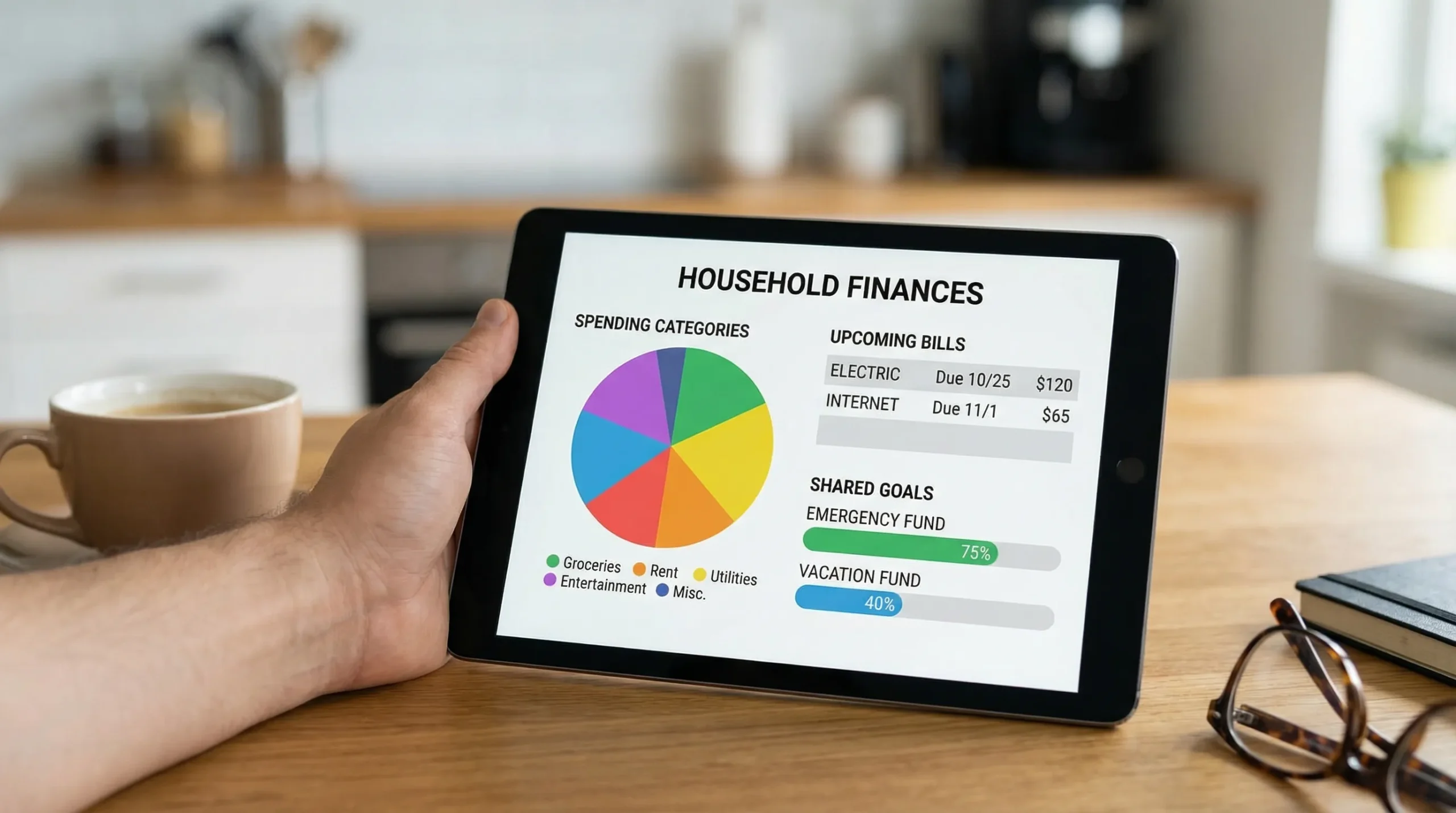
Use one dashboard to see the household money story
Couples rarely struggle because they are irresponsible. They struggle because information is scattered.
With a unified personal finance dashboard, you can monitor expenses, income, bills, debt, and investments in one place, so decisions are based on the full picture rather than partial account snapshots.
Track bills and debt so payments do not become a relationship issue
When both partners assume the other person handled a bill, late fees happen.
MoneyPatrol includes bill and debt tracking plus customizable alerts and reminders, which can help keep recurring obligations visible and reduce the mental load on whichever partner usually remembers due dates.
Make budgets less emotional with clear reporting
A couples budget works best when it is based on facts, not impressions.
MoneyPatrol provides detailed financial reports and expense tracking that help you answer questions like:
- What did we actually spend on groceries last month?
- Are we trending up or down on dining?
- How much did irregular expenses (gifts, travel, medical) impact our goals?
That shift, from opinion to evidence, makes money conversations calmer.
Keep your data clean with transaction review and reconciliation
Couples make bigger decisions, so accuracy matters.
MoneyPatrol supports account reconciliation, helping you confirm that transactions are captured correctly and categorized in a way that makes your budget meaningful.
Include net worth, not just spending
Many couples budget only to “control spending,” then ignore the bigger objective: building net worth.
MoneyPatrol also supports investment tracking and credit score monitoring, which can be helpful if you are planning for a home purchase, refinancing, or simply trying to improve financial stability over time.
If you want a broader overview of budgeting features (beyond couples use), you can also read MoneyPatrol’s guide to the best free budgeting app.
A quick decision checklist for choosing the best couples budget app
When you compare options, ask these questions. If the answer is “no” to several, keep looking.
- Can we track shared bills and get reminders before due dates?
- Can we monitor spending by category and see trends over time?
- Does it support budgeting plus bills, debt, income, and investments (not just one area)?
- Can we review and correct transactions so the budget stays accurate?
- Will it help us track shared goals in a way we will actually look at weekly?
The best couples budget app is the one that fits your money model (merged, hybrid, separate) and reduces the amount of manual coordination you have to do.
A small but useful bonus: align your “life admin,” not just your budget
Couples who budget well often streamline other shared systems too: calendars, household tasks, even how you present yourselves online for side projects or creator work.
If you are building something together (a small business, a content channel, a portfolio), your profile image is often the first impression. A free tool like Social Previewing can help you preview profile pictures and cover images across major social platforms before you publish.
Putting it all together
Splitting bills and tracking goals is not about turning your relationship into an accounting exercise. It is about replacing ambiguity with shared visibility.
A solid couples budgeting setup has:
- A clear agreement on what is shared vs personal
- Reliable tracking (expenses, bills, debt, income)
- Alerts so nothing slips through the cracks
- Reports that show progress and trends, not just totals
MoneyPatrol is built around those fundamentals, with free expense tracking and a comprehensive dashboard that can support how couples actually manage money in real life.


 Our users have reported an average of $5K+ positive impact on their personal finances
