

Money fights rarely start with a spreadsheet. They start with surprises, like a credit card balance you did not expect, a “quick” Target run that became $180, or a bill that hits a day before payday.
That is why the best app for budgeting for couples is not just the one with the most charts. It is the one that makes sharing simple, keeps both partners oriented around the same goals, and reduces the “Did you really need that?” conversations.
Below is a practical guide to choosing (and actually using) a couples budgeting app so you can share finances without stress, regardless of whether you split everything 50/50 or keep some money separate.
Why budgeting as a couple is uniquely hard
Couples budgeting has more moving parts than solo budgeting, even when both partners are responsible and well intentioned.
First, you are combining two different “money operating systems.” People bring different risk tolerance, spending triggers, and definitions of what “being careful” means. Second, households now have more recurring charges than ever, streaming, software, delivery memberships, gym dues, and “free trials” that are not really free.
And when disagreements happen, they matter. Research published in Family Relations found that financial disagreements are associated with higher relationship conflict and can be a strong predictor of divorce (Jeffrey Dew, 2011).
The good news is that budgeting apps can lower conflict if they are set up to:
- Make shared spending visible without turning it into surveillance
- Reduce surprises through bills, alerts, and reminders
- Provide a consistent “source of truth” for decisions
What the best app for budgeting for couples should do (a couples-first checklist)
At a minimum, a couples budgeting app should help you answer four questions quickly:
- Where did our money go?
- What is coming next (bills, debt payments, irregular expenses)?
- Are we on track for our shared goals?
- What needs attention right now?
Here is a grounded way to evaluate apps, based on real couple workflows.
| Capability | Why couples need it | What “good” looks like |
|---|---|---|
| Expense tracking with categories | Prevents “mystery spending” arguments | Clear categories, easy recategorization, fast search |
| Budgeting tools | Turns values into spending limits | Flexible budgets by category and by month |
| Bill and debt tracking | Reduces late fees and stress | Due dates, reminders, progress tracking |
| Income management | Makes uneven or variable pay easier | Multiple income sources, predictable cash flow view |
| Alerts and reminders | Prevents surprises and missed tasks | Customizable alerts that are actionable, not noisy |
| Account reconciliation | Builds trust in the numbers | Ability to review, confirm, and correct transactions |
| Reports and trends | Supports calm conversations | Simple monthly summaries you can review together |
| Investment and credit monitoring (optional) | Helps couples align long term | One place to see progress and risk signals |
If an app does not handle the top four items well (expenses, budgeting, bills, alerts), it will feel like extra work, and extra work is where couples budgeting fails.
“Sharing without stress” starts with a system, not a tool
Many couples download a budgeting app and immediately get stuck on a bigger question: “Are we combining everything or keeping money separate?”
A budgeting app cannot solve that for you, but it can support whichever structure you choose.
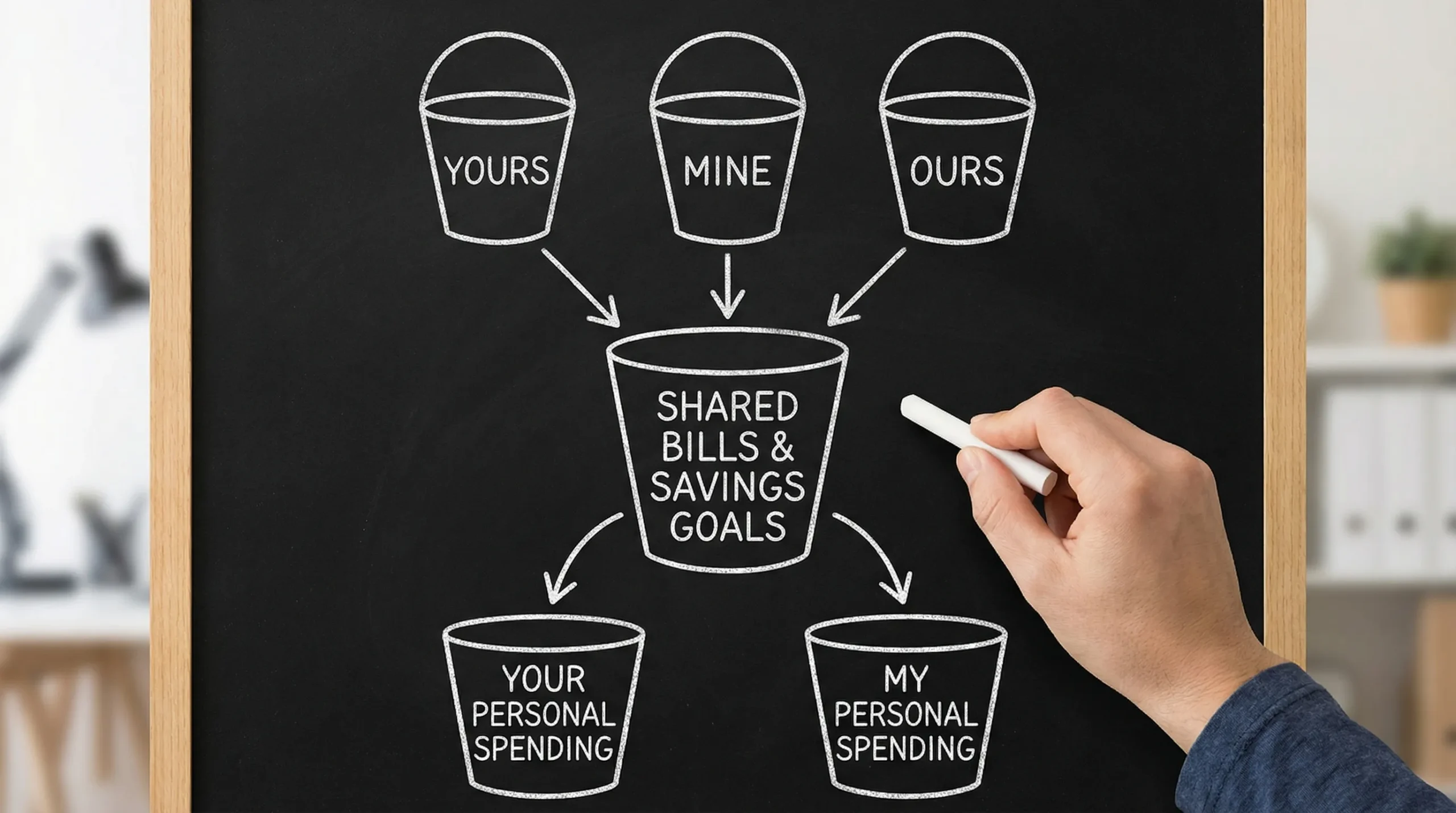
A simple system that works for many couples is Yours / Mine / Ours.
- Ours covers household essentials and shared goals (rent or mortgage, utilities, groceries, insurance, childcare, debt, saving).
- Yours and Mine cover personal spending with no commentary attached (hobbies, gifts, personal subscriptions, friend trips).
This approach lowers stress because it creates clear lanes. You still track everything, but not everything is a debate.
A practical way to fund the shared lane
Instead of arguing about fairness, pick a funding rule that matches your reality:
- 50/50 split if incomes and obligations are similar.
- Proportional split if incomes are different (each contributes the same percentage of income to shared costs).
- Role-based split if one partner covers certain categories consistently (for example, one covers housing while the other covers childcare).
Whatever rule you choose, the app should make it easy to see the shared categories and track whether you are staying within budget.
Set up your couples budget in 30 minutes (the low-friction way)
You do not need a perfect budget to get benefits. You need a usable one.
Step 1: Agree on the only two goals that matter this month
Keep it tight. Examples:
- Build a $1,000 starter emergency fund
- Pay down one credit card by $300
- Cap dining out at $250
When couples pick eight goals, they usually end up with zero.
Step 2: Create “boring but powerful” categories
Couples budgets work best when categories match decisions you actually make. A practical starting set:
- Housing
- Utilities
- Groceries
- Dining out
- Transportation
- Subscriptions
- Health
- Debt payments
- Savings and goals
- Fun money (separate for each partner)
Then add one “irregular” category for things like gifts, annual renewals, car maintenance, and travel. Many budget blowups happen in irregular spending, not in daily coffee.
Step 3: Add bills and due dates before you obsess over spending
Late fees and overdrafts create instant stress. If your app supports bill tracking and reminders, set those up early so you are protecting the relationship from avoidable friction.
Step 4: Choose your rules for “alerts”
Alerts are helpful only when both partners agree what they mean. For example:
- Alert when a bill is due within 7 days
- Alert when a category hits 80 percent of the limit
- Alert for large transactions over a set amount
If your app lets you customize alerts and reminders, use that to reduce surprise spending conversations.
How to use a budgeting app as a couple (without making it a second job)
The best couples budgeting routine is consistent, short, and non-judgmental.
Try a weekly 10-minute “money check-in” using your app’s dashboard and reports:
- Review the last 7 days of transactions and quickly recategorize anything wrong
- Check 2 to 3 categories that tend to drift (often dining out, groceries, and shopping)
- Confirm upcoming bills and the account they will be paid from
- Decide one small action for the week (pause a subscription, move money to savings, adjust a limit)
A key relationship tip: treat the app as the referee, not your partner. You are both on the same team, looking at the same scoreboard.
Red flags: when a “budgeting app for couples” creates more stress
Some apps look great in ads but fail in real life couple dynamics. Watch out for:
- Too much manual entry: if you have to log every purchase, the system breaks during busy weeks.
- No reconciliation or review workflow: couples lose trust when numbers feel off and cannot be corrected.
- Rigid categories: if you cannot adapt categories to your household, you end up fighting the tool.
- No bill visibility: budgets fail when upcoming obligations are hidden.
- Noisy notifications: constant pings turn budgeting into nagging.
You want an app that reduces cognitive load, not one that adds it.
Where MoneyPatrol fits for couples
MoneyPatrol positions itself as a free, comprehensive personal finance and budgeting app with an all-in-one dashboard. For couples, that “single place to look” matters, because shared clarity is what prevents conflict.
Based on MoneyPatrol’s stated feature set, it can support a couples workflow in a few practical ways:
A shared picture of spending and cash flow
MoneyPatrol includes expense tracking, income management, and a personal finance dashboard, which are the basics you need to get out of “I think we are fine” mode and into “Here is what actually happened.”
Fewer surprises with bills, debt, and alerts
For households juggling multiple due dates, MoneyPatrol’s bill and debt tracking plus customizable alerts and reminders can be useful for preventing the avoidable stress events, like missed payments or a category that runs hot halfway through the month.
Better trust in the numbers
Couples argue less when they trust the system. MoneyPatrol lists account reconciliation and detailed financial reports, which are important for verifying transactions, correcting categorization, and reviewing month-end results together.
Long-term visibility beyond the monthly budget
MoneyPatrol also lists investment tracking and credit score monitoring. Not every couple needs these early on, but they are valuable when you are aligning on bigger goals like buying a home, refinancing debt, or planning a major purchase.

A quick “couples compatibility” test before you commit to any app
Before you pick the best app for budgeting for couples, do this small test together:
- Can we both understand the dashboard in under 60 seconds?
- Can we find last weekend’s spending and agree on categories quickly?
- Can we see upcoming bills and due dates clearly?
- Can we set category limits that match how we actually live?
- Can we export or review reports to support a calm monthly recap?
If you cannot answer “yes” to most of these, keep shopping.
A small but surprisingly helpful tip: make “shared” feel shared
Couples who succeed at budgeting often make the system feel like a joint project. That includes the small details, like naming your budget, using a shared calendar reminder for the weekly check-in, or even using a consistent profile image for a joint side hustle or joint creator account that is funding a goal.
If you ever need to sanity-check how a profile photo will look across platforms, a tool like Social Previewing’s free profile picture previews can help you see your image on major social networks before you publish.
The bottom line
The best app for budgeting for couples is the one that:
- Makes shared spending visible and easy to review
- Tracks bills and debt so you do not get blindsided
- Uses alerts to prevent problems, not create tension
- Produces reports that support calm, short money conversations
MoneyPatrol is designed as an all-in-one personal finance dashboard with expense tracking, budgeting, bill and debt tracking, alerts, reconciliation, and reports, all of which map well to what couples typically need to share money without stress.
If you want the process to stick, keep your setup simple, adopt a Yours / Mine / Ours structure, and commit to one short check-in per week. Consistency beats perfection in couples budgeting.


 Our users have reported an average of $5K+ positive impact on their personal finances
